
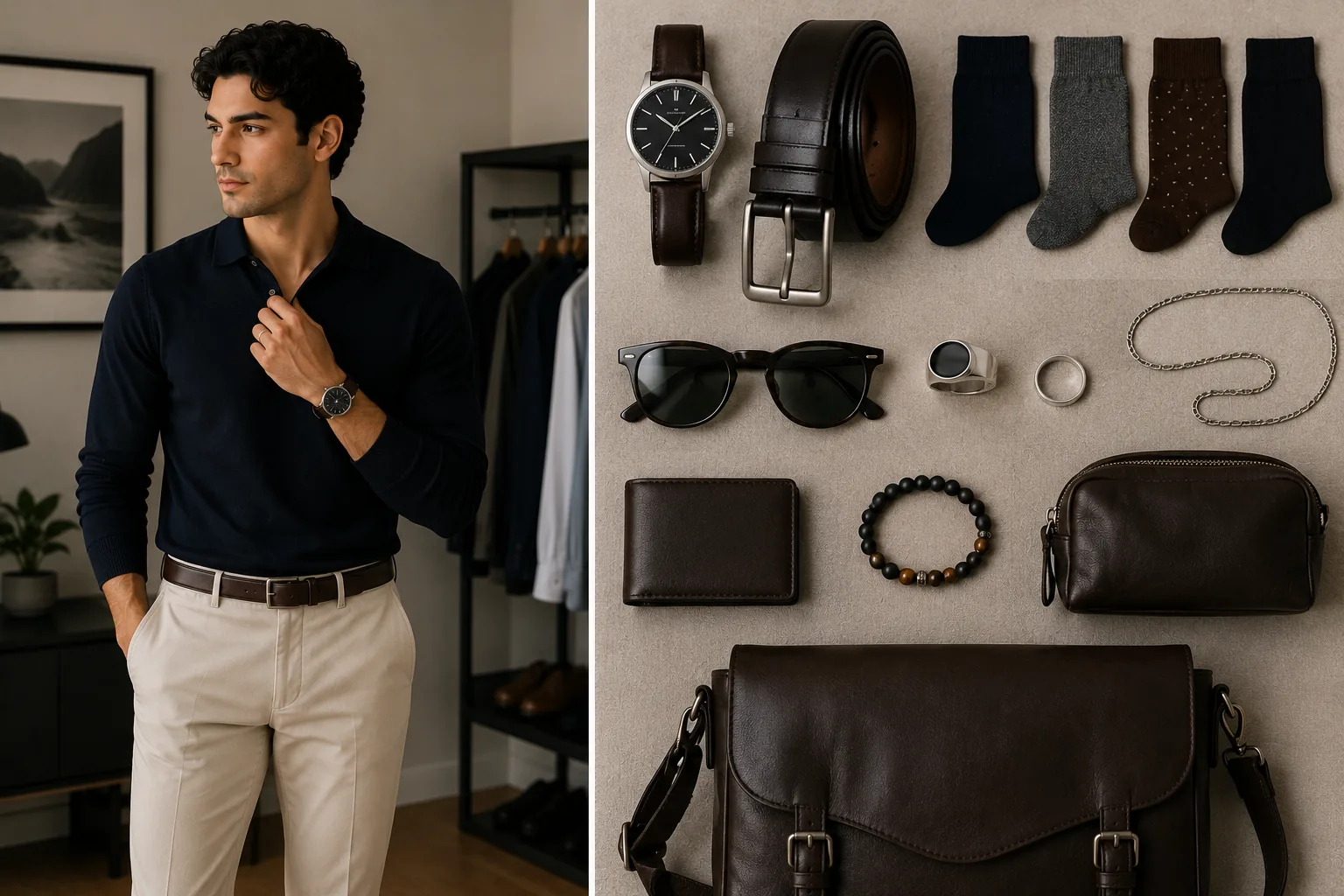
The working three: watch, bag, jewellery
Three accessories do jobs, which is why they never look like decoration. A watch anchors the wrist and signals that details get your attention — one honest piece worn daily beats five rotated. A bag exists to agree with your shoes: match the leathers where you can — tan with tan, black with black — and keep the hardware simple.
Jewellery is the accessory most women choose without noticing they are choosing. Delicate layered chains or a single statement piece for dressier days; studs or small hoops for daily wear; bangles or a kada as a constant rather than an event. Nothing on this list is optional so much as already happening — the choice is only whether it happens on purpose.
Layering jewellery without it becoming a costume
Jewellery works when it looks inevitable and fails when it looks applied. The reliable entries: a fine chain or two at different lengths, a signet or plain band, small hoops or studs, a bangle stack in one metal tone.
Two rules keep it clean. Pick one metal family per outfit — the watch counts, so a gold watch argues for gold-toned jewellery. And add pieces one at a time, worn for a fortnight before the next, so each becomes yours rather than a costume arriving all at once. For the full mechanics of stacking chains and rings without overdoing it, see how to layer jewellery.
Sunglasses and spectacles: frames for the face
Sunglasses are the accessory strangers judge from furthest away, and fit beats brand at every price. The frame should run about as wide as your face, eyes centred in each lens, no pinching at the temples. Broadly, frames balance faces by contrast — angular frames sharpen softer faces, rounder frames ease angular ones — and a classic oversized or cat-eye shape lands somewhere useful on almost everyone.
One good pair with genuine UV protection, kept in its case rather than pushed up into the hair all day, outdresses a drawer of impulse pairs. If you wear spectacles daily, treat them as the most-worn accessory you own and spend accordingly — they are in every photograph of you from now on.
Bags, belts, and the things you carry
The bag is part of the outfit whether you planned it or not. A gym duffel over office tailoring undoes the tailoring; a decent bag upgrades even a plain tee and jeans. The working set is two: a clean tote or structured crossbody for daily life, and a small clutch or top-handle bag for days that matter.
Colour logic mirrors shoes — tan, brown, black and navy cover everything, and matching bag leather to shoe leather quietly organises the whole look. A single good belt, worn at the natural waist over a shirt or dress, does more shaping work than most tailoring.
The same scrutiny applies to the small carry: a wallet that has not exploded with receipts, a phone case in a sober colour. Frayed edges at the touchpoints leak effort you spent everywhere else.
The two-or-three-piece ceiling
The difference between accessorised and cluttered is subtraction. Watch and a single ring barely count — beyond those, two or three deliberate pieces per outfit is plenty and four is the ceiling: watch plus a stack of thin bangles, earrings plus better sunglasses, a scarf plus one statement necklace. Past that, pieces stop being noticed individually and start being counted.
Match the register too. Fine gold jewellery belongs with tailoring; chunky silver and a canvas tote belong with weekend denim; festival bangles and jhumkas can scale up with ethnic wear, where more was always the tradition.
Before leaving, one look in the mirror: remove whichever piece you notice first. What survives is accessorising — everything else was decoration looking for permission.