 SKIBDRIP®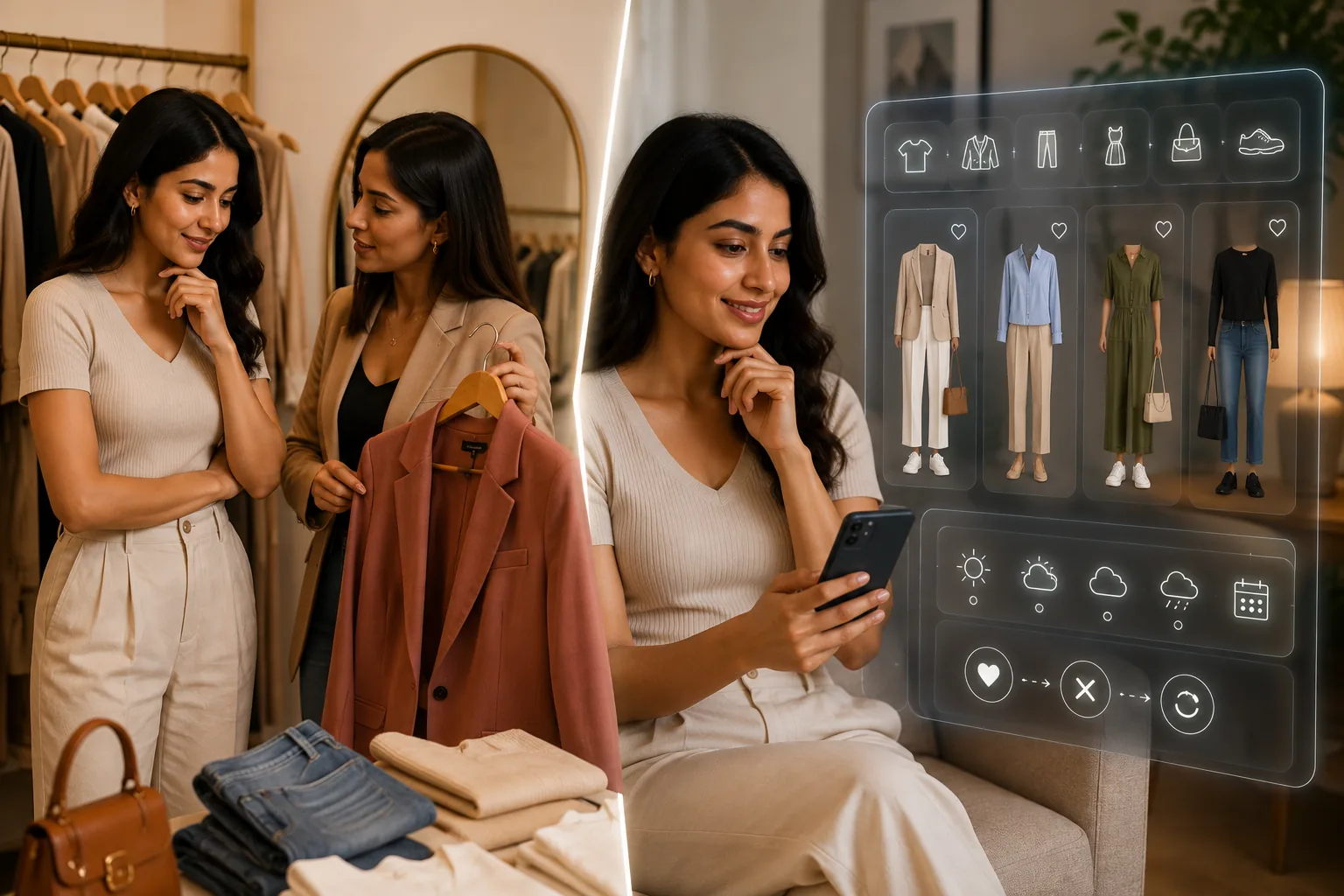
What you are actually buying from a human
A good human stylist sells judgement plus presence. In a session they read your proportions in person, pull garments you would never touch, pin and tuck in real time, and deliver the tactful sentence a friend will not: that jacket is wearing you. They navigate shops on your behalf, know tailors by name, and can rebuild a wardrobe's entire direction in one determined afternoon.
The structural limits are cost and cadence. Sessions in Indian metros commonly run from a few thousand rupees upward, so most clients meet a stylist a handful of times — for an overhaul, a wedding season, an image change. The remaining three hundred and sixty mornings of the year, you are alone with the cupboard again. Depth is the product; scarcity is the price.
What you are actually buying from software
An AI stylist sells judgement multiplied by frequency. It holds your entire wardrobe in memory — no human retains four hundred garments — cross-references weather, calendar and occasion, and answers every single morning in seconds, without fatigue, mood or a waiting list. It never judges the body in the photo, never sighs at a budget, and explains its reasoning if it is built honestly.
Its limits mirror the human's strengths: no hands, so nothing gets pinned; no fitting-room instincts beyond its data; and a cold start — the first fortnight runs on principles rather than intimacy while it learns your taste from feedback. Software is a daily companion, not an event.
Run the cost-per-decision maths
Price the two against the job, not against each other. A human session's fee, divided by the handful of decisions it directly shapes, prices each decision in the hundreds of rupees — entirely worth it when the decision is a bridal trousseau or the interview that changes your decade. An AI subscription divided across thirty mornings a month prices the daily decision at less than a cup of chai.
Neither number makes the other wrong; they price different problems. High-stakes, low-frequency decisions justify human depth. Low-stakes, high-frequency decisions — the daily what-do-I-wear — only make economic sense automated. Most wardrobes contain both kinds of problem, which is the real answer quietly forming.
Where each one fails
Choose a human alone and the gaps appear between sessions: the advice ages as seasons and bodies change, the wardrobe drifts off-plan, and the daily decision stays unsolved eleven months a year. There is also a taste risk — a strong stylist can dress you as their brand rather than yours, and charge you for the privilege.
Choose AI alone and the gaps are physical: no fitting-room presence, no pinned hem, no firm hand pulling you out of a rut it has politely learned to serve. Software optimises within your feedback; a good human occasionally overrules your feedback for your own good. Knowing which failure costs you more this year is most of the decision made.
The verdict, by situation
- Big transformation — new job level, post-weight-change wardrobe, bridal season: book the human; depth wins
- The daily decision — office mornings, packing, festive functions: use the AI; frequency wins
- Both budgets available: human once to set direction, AI every day to execute it — the combination outperforms either alone
- Tight budget: AI first; it solves the problem you have three hundred times a year for roughly the price of one human hour
The question was never really which is better. It is which mornings you need help with — and almost everyone's honest answer is: most of them, including tomorrow's.