 SKIBDRIP®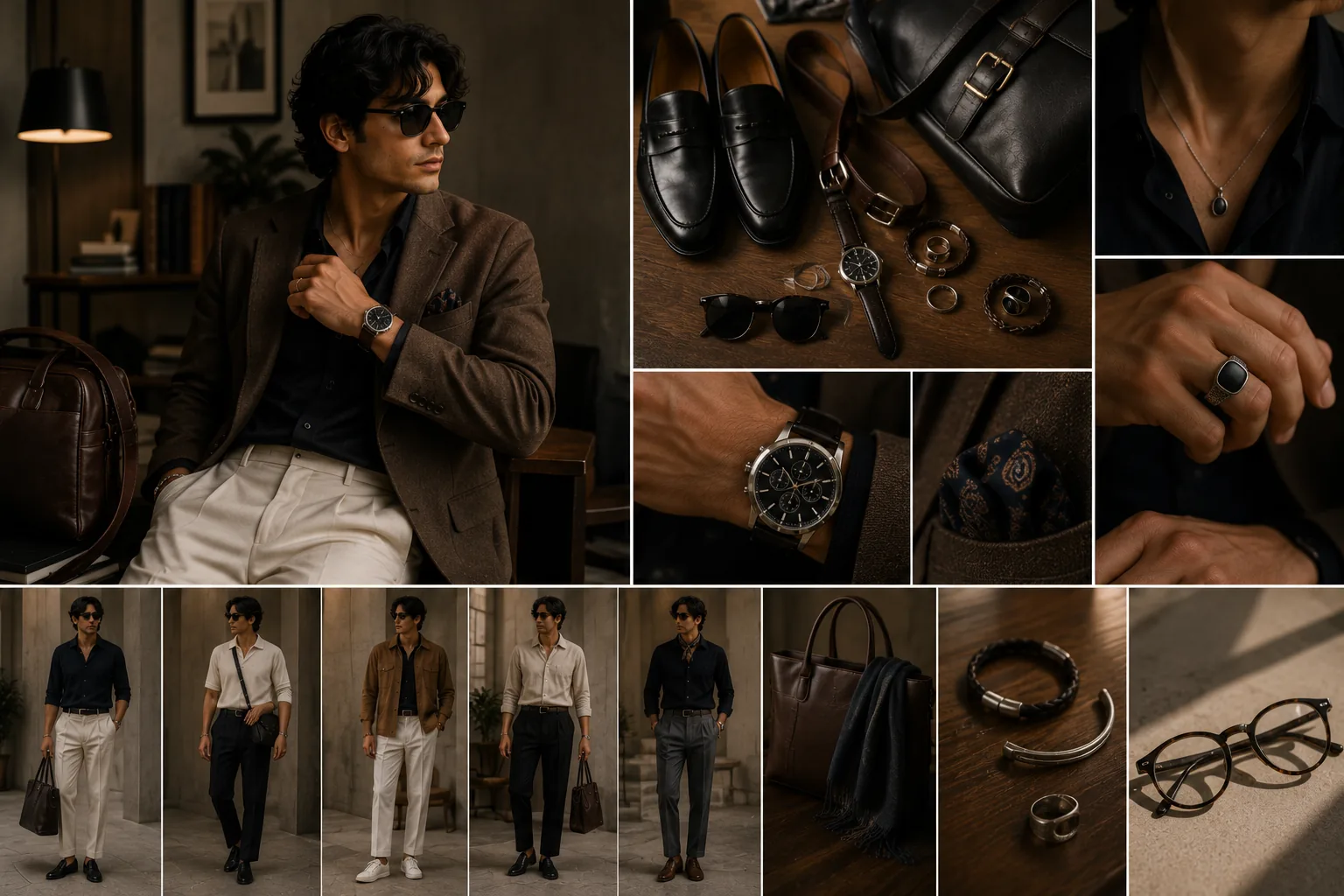
Why accessories carry so much weight
Clothes cover you; accessories describe you. They are the only wardrobe decisions with no practical alibi — nobody needs an earring — so every one reads as pure intent. That is their power: a plain outfit with one deliberate object looks chosen, while a good outfit with random extras looks accidental.
It is also why restraint outperforms budget here. Two considered pieces beat five competing ones on any body, at any price. Think of accessories as punctuation — they end the sentence; they are not the paragraph. Learn the order of operations below and the whole subject takes two minutes a day.
Start at the foundation: shoes and bag
Before jewellery enters the conversation, the two accessories you cannot skip are already talking. Shoes set the outfit's formality and can make or break the whole look; the bag sits at eye level in every interaction and announces its own register — structured leather says work, soft slouch says weekend, tiny crossbody says evening.
Get these two agreeing with the outfit and with each other — similar formality, compatible colour temperature — and you are eighty per cent accessorised before a single ornament goes on. Condition matters as much here as choice — a scuffed shoe or a fraying strap outshouts any jewellery decision made afterwards.
Choose one focal point
The eye wants one place to land. Pick a single focal accessory per outfit: a watch with presence, one bold pair of earrings, a silk scarf at the neck, a statement ring, a good hat. Everything else drops to supporting cast.
Place the focal point where you want attention — near the face for conversation-heavy days (earrings, scarf, glasses), at the wrist for expressive hands, at the waist to mark a silhouette. Two focal pieces split the vote; three start an argument. One object, clearly the point, is what reads as taste.
The quiet supporters
Supporters coordinate without demanding credit: a belt that agrees with the shoes, a fine chain, small studs, a plain-band ring, your everyday glasses. Their rules are about harmony:
- Metals: pick a lead metal per outfit — gold with warm palettes, silver with cool; one deliberate two-metal piece can bridge both
- Leathers: belt and shoes in the same family, exact match only at peak formality
- Scale: fine pieces with fine fabrics, chunkier pieces with heavy knits and denim
Supporters should be felt as coherence, not counted as items.
Accessorising by occasion
The system flexes by setting; only the focal point really changes. Work: the watch or the glasses lead, everything else whispers — matched leathers, small studs, no noise. Evening: the focal moves up a register — the bolder earring, the silk at the neck, the dressier shoe — while the count stays identical. Festive and wedding wear: jewellery finally stars in multiples, though even here one hero piece anchored by quieter companions beats five heroes fighting.
Daily errands: shoes, bag, one small constant — the everyday chain or the watch — and done. The discipline never changes: pick where the eye should land for this room, this light, this company, and let every other piece agree quietly.
Know when to stop
The old dressing-table advice — look once in the mirror and remove one thing — survives because over-accessorising is the common failure, not under. A practical ceiling: shoes, bag, one focal piece, two supporters. Beyond that, pieces stop adding and start diluting each other.
Build a small kit you trust instead: one good watch or bracelet, one pair of earrings that catches light, one scarf, one belt per shoe colour, one pair of sunglasses that fit. A dozen dependable objects accessorise a whole year better than a drawer of maybes.