 SKIBDRIP®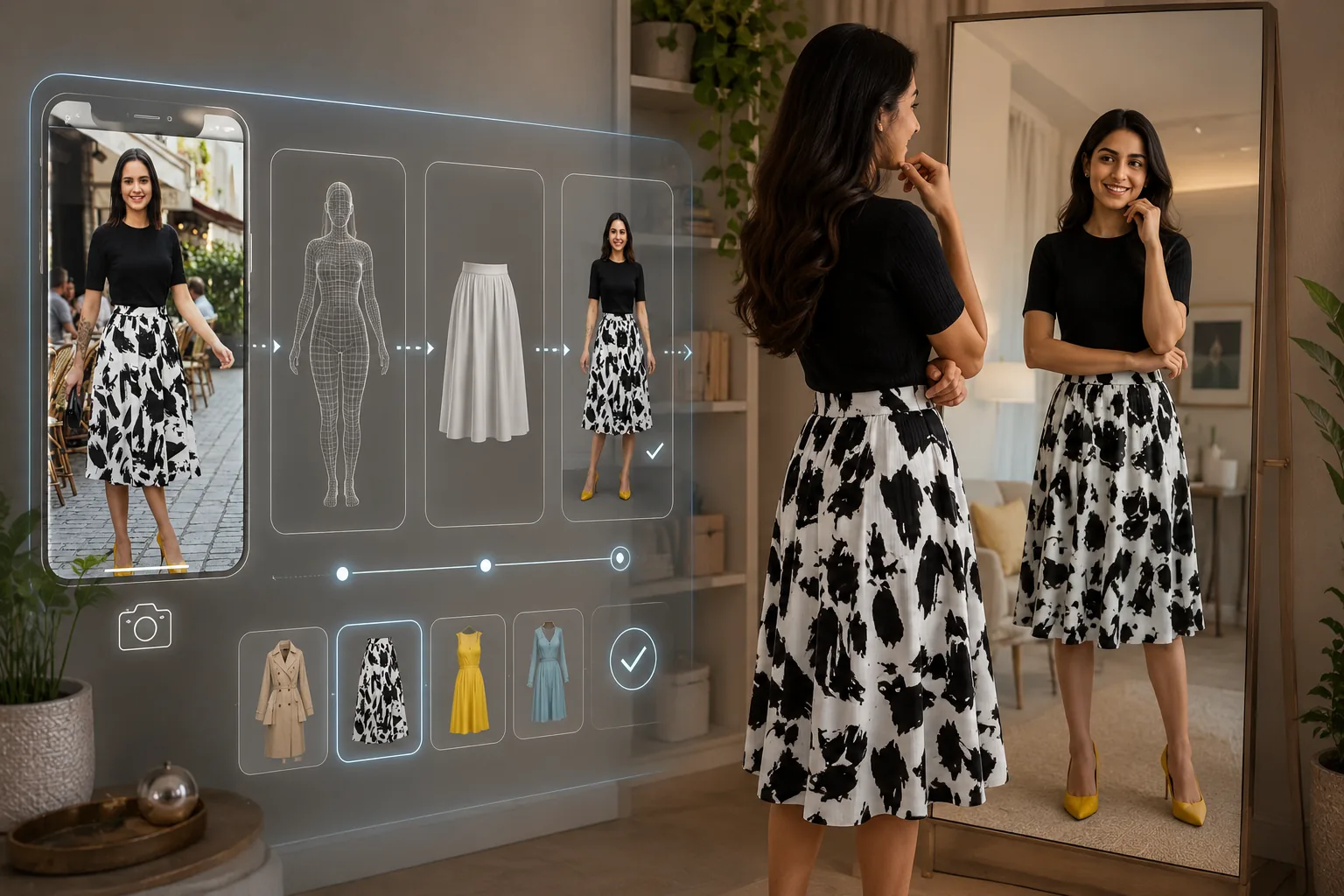
Two technologies share one name
Virtual try-on is really two families. The lighter, commoner one is 2D image-based try-on: you supply a photo, software detects your pose and body outline, then warps a garment image onto you, matching perspective, scale and lighting. Modern generative models make the composite convincing — believable fabric folds, shadows that land where physics says they should.
The heavier family is 3D simulation: a body model built from measurements or a scan wears a digitally constructed garment with real physical properties — weight, stretch, stiffness — and cloth physics decides the drape. Retail mostly runs the first, because it needs only your photo and the product shot; the second powers made-to-measure tailoring and design studios, where accuracy pays for the effort.
What happens to your photo, step by step
A typical 2D pipeline runs four steps in a few seconds. Pose estimation locates your joints and orientation. Segmentation separates you from the background and from the clothes you are already wearing. The garment image is then deformed to your geometry — stretched at the shoulders, folded at the waist, occluded where an arm crosses the torso. Finally a rendering model blends light and shadow so the composite reads as one photograph rather than a sticker.
Each step has known failure points: unusual poses confuse the skeleton, loose existing clothing corrupts the body estimate, dim light breaks colour fidelity. The practical advice writes itself — stand straight, front-on, in fitted clothes and even daylight, and the technology performs near its best.
What try-on is genuinely good at
Used within its limits, virtual try-on answers questions that once required a trial room. How a colour sits against your skin in honest light. Whether a hem length suits your leg line, or a neckline your shoulders. How a silhouette changes your proportions — the difference between a cropped and a longline jacket on your specific torso, not a model's.
It is also a superb elimination tool: culling seven of ten candidates before any money moves. For online shoppers that is the entire practical value — fewer doorstep disappointments, fewer return pickups, fewer maybes hanging unworn with tags attached. Try-on will not tell you what to buy, but it is increasingly good at showing you what not to.
Where it still fails: fit is not look
The hard limit: a warped image knows nothing about tension. Whether a shirt pulls at the buttons, a waistband digs after lunch, a sleeve binds at the shoulder — those are interactions between real cloth and real flesh, and 2D try-on cannot compute them. Even 3D simulation depends on accurate body measurements and honest fabric data, and both are frequently missing from the pipeline.
So treat try-on output as a styling preview, never a fitting. Size decisions still belong to measurement charts, your known dimensions and the understanding that fit matters more than size. When an app shows you looking great in a garment, it has answered look — fit remains unverified until fabric actually meets body.
Try-on is not styling — and the photo question
Seeing one garment on your body answers one question. Styling — what to wear together, for this weather, that occasion, your taste — is a different computation, done by outfit generators reasoning over your whole wardrobe. The technologies complement rather than compete: try-on helps you buy the right piece; styling helps you wear everything you already own.
Before using either, apply the photo test: know whether your images train models beyond your account, whether they are shared with third parties, and whether deletion is real. Body imagery deserves the same caution everywhere it travels — a tool being impressive is not the same thing as a tool being careful.