 SKIBDRIP®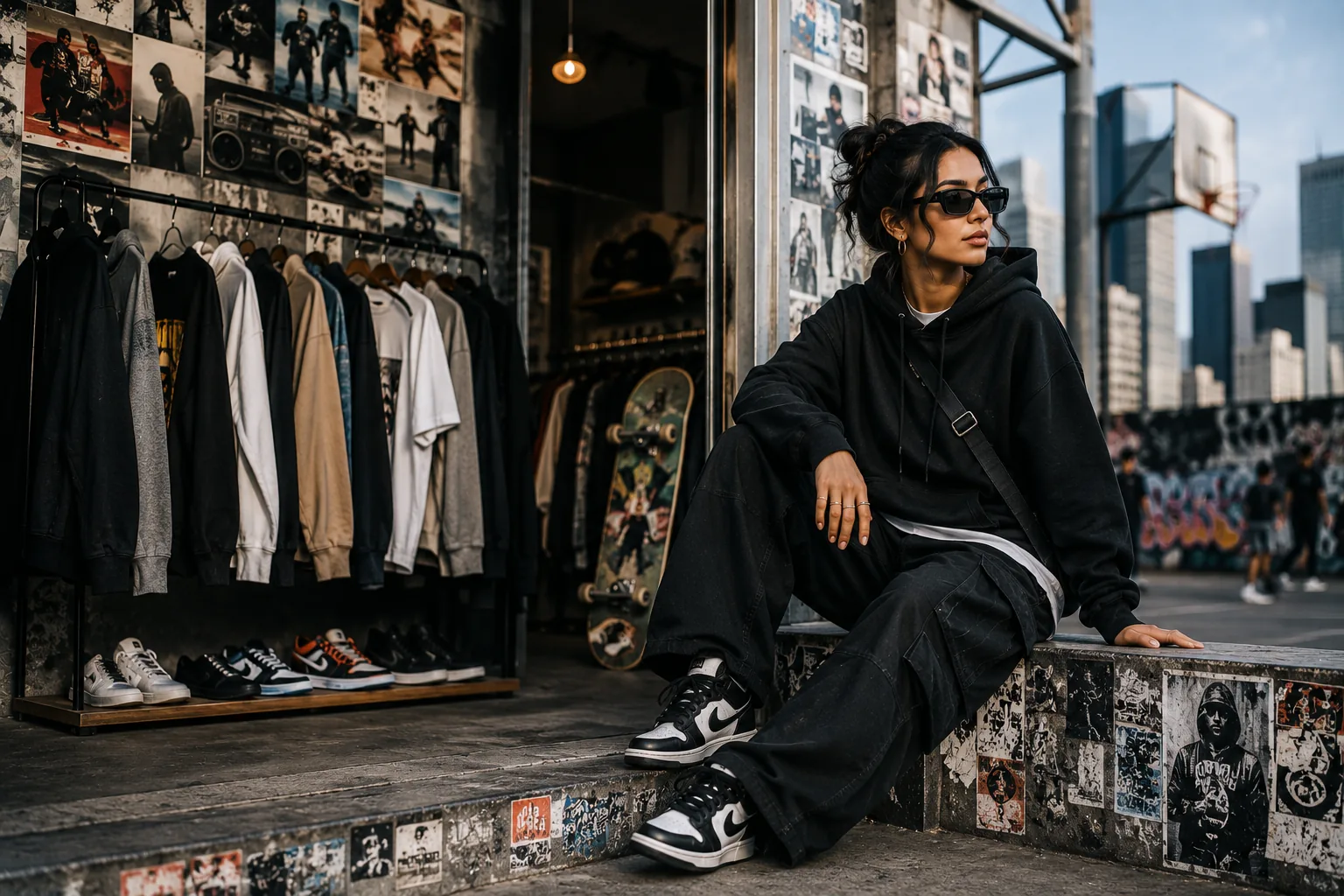
Where it comes from
Streetwear was never designed top-down; it accreted from scenes. Californian surf and skate shops in the 1980s started printing tees and selling identity along with boards. New York hip-hop supplied the silhouettes, the swagger and the idea that style credentials come from the street, not the runway. Tokyo — Harajuku's obsessive makers and tiny labels — added craft, scarcity and the collector mentality.
What unified them was the same mechanism: clothes as membership. A graphic tee was a flag; recognising it on a stranger was the point.
Everything that later looked like marketing genius — small drops, long queues, insider knowledge — began as the natural economics of subcultures making things for their own people first.
The grammar: what streetwear is made of
The canon is stable even as fits rotate:
- Graphic tees — the original unit of meaning; the print is a reference, a joke, an allegiance
- Hoodies and crewnecks — the everyday armour
- Sneakers — the centre of gravity; entire subcultures orbit silhouettes and colourways, and white leather pairs remain the neutral everything else plays against
- Workwear and military borrowings — cargos, chore jackets, canvas and nylon
- Caps, beanies, crossbody bags — the finishing hardware
Fit is the era-marker: baggy in the 90s, skinny through the 2010s, and by 2026 settled into roomy-but-considered — wide trousers, boxy tops, deliberate proportion rather than accidental slouch. The pieces are ordinary on purpose; the meaning rides on references and combination.
The drop, the queue, the resale market
Streetwear's second invention was economic. The drop model — small quantities, announced dates, no restocks — turned buying clothes into an event, and scarcity into the product. Queues outside shops became the subculture's public theatre; the resale market became its stock exchange, with certain sneakers trading at multiples of retail.
Understanding this explains both the culture's energy and its 2020s exhaustion. When resale flippers outnumbered wearers, the signal collapsed — owning the rare thing stopped meaning you belonged and started meaning you had refresh discipline.
By 2026 the frenzy has visibly cooled: drops persist, but the wiser end of the culture has drifted back towards wearing over holding, and towards labels with something to say.
The luxury merger and the 'death' of streetwear
The 2017-2021 stretch rewired fashion's hierarchy: skate-born labels collaborated with heritage houses, and Virgil Abloh's appointment at Louis Vuitton put a streetwear-native designer at the summit of European luxury. Hoodies walked in couture shows; the runway learned the drop.
Then came the famous 2022 declaration — from inside the culture itself — that streetwear was dead. What actually died was streetwear as novelty and as speculative asset. The clothes, the references and the community logic did not die; they dispersed into everything. Tailoring brands cut boxy; luxury sells sneakers as a matter of course.
Call 2026's version post-streetwear: no longer a rebellion outside the gates, because it owns several of the gates.
Wearing it honestly in 2026
Streetwear rewards fluency over spend, which makes starting simple.
Begin with fit and proportion — one roomy element balanced by one neater one — in plain pieces: a heavyweight blank tee, straight-leg workwear trousers, clean sneakers. Add one graphic you can stand behind; the culture's oldest rule is knowing the reference on your own chest. Keep sneakers clean — care is credibility. Ignore resale maths; buying to wear is the honest position. And blend freely: streetwear pieces inside a broader personal style — a hoodie under tailoring, cargos with a fine knit — is exactly how the culture itself dresses now.
Worn this way, streetwear in 2026 is simply what it always claimed to be: comfortable clothes that say something, chosen by someone who knows what they are saying.