 SKIBDRIP®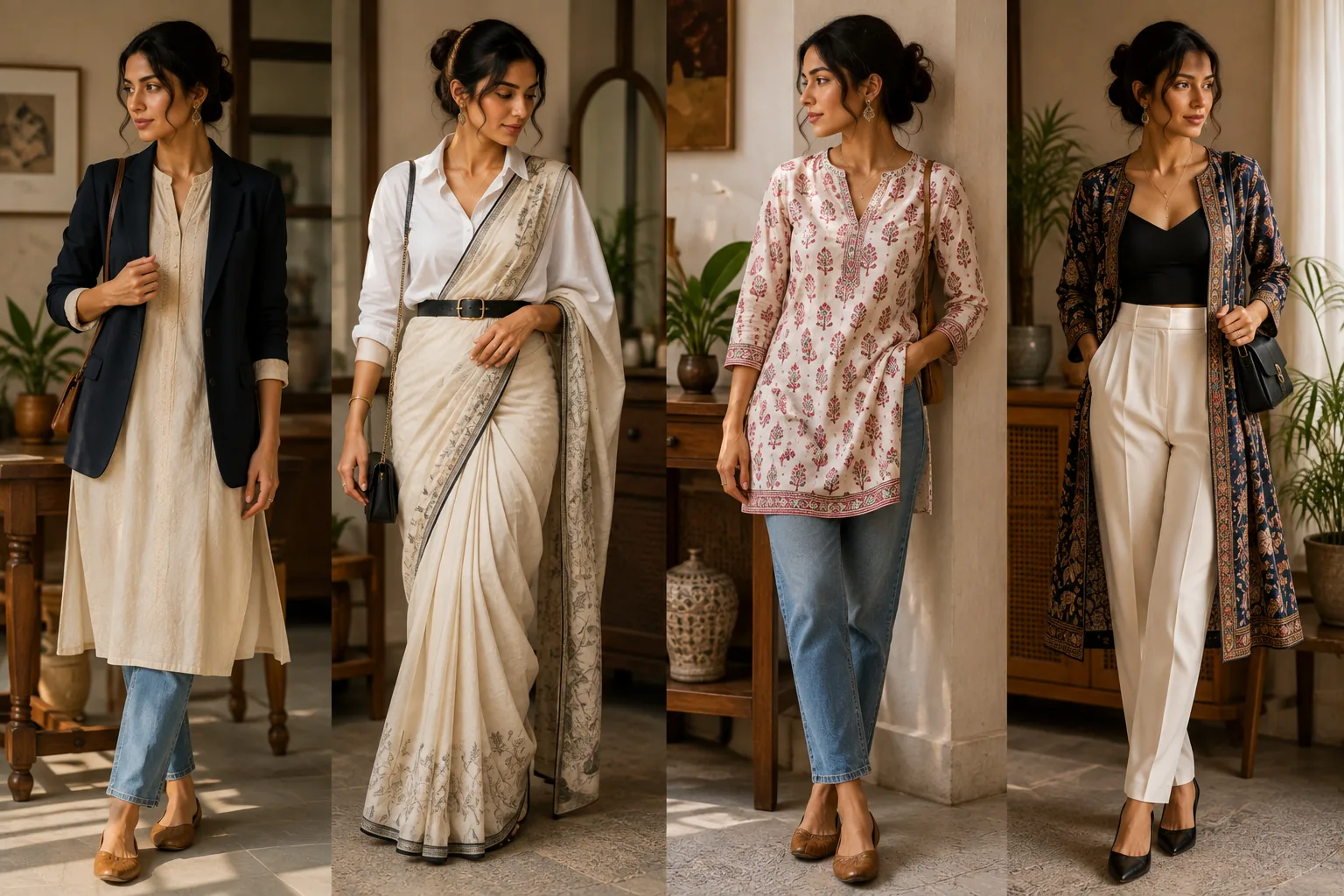
The one-swap rule
Fusion fails at fifty-fifty. It works when one language leads and the other contributes exactly one word.
Start with a complete outfit — fully western or fully Indian — then swap a single piece across the border: a bandhgala over grey trousers, a chikankari kurta into a denim look, juttis under cropped chinos, a crisp shirt as a saree blouse. The base gives the outfit its grammar; the swap gives it a point of view. Two swaps demand confidence and a mirror check. Three, and you are in costume territory — the eye stops reading intention and starts reading confusion. When a fusion look fails, count the swaps; the number is almost always the diagnosis.
Six swaps that always work
- Short kurta, straight jeans, white sneakers — the national default, still unbeaten
- A crisp shirt as a saree blouse — tucked tight, collar open, office-ready with cotton and chiffon
- An unstructured blazer over a solid kurta — meetings, dinners, airports
- A Nehru jacket over a shirt and chinos — festive enough for a side function, sharp enough for work
- A bandhani or ajrakh dupatta worn as a scarf over a white tee and jeans
- Juttis or kolhapuris under western tailoring — the cheapest, easiest swap of all
Each one keeps a complete outfit intact and lets a single piece cross over. Start with the last one tonight; if it feels natural, work upward — kurta styling covers the first in depth.
Balance structure against flow
Indian pieces tend to flow — kurtas, dupattas, palazzos, drapes. Western pieces tend to structure — blazers, jeans, collared shirts. Fusion looks intentional when each outfit holds one of each: a floaty kurta over rigid denim, a fluid saree against a starched collar, a sharp bandhgala above easy trousers.
Match flow with flow and the look drifts towards beachwear; structure with structure and it stiffens into uniform. Fit does the persuading — the western piece should fit properly by western rules, the Indian piece drape properly by Indian ones. A gaping blazer over a perfect kurta reads as borrowed, not styled, and the whole experiment gets blamed for one bad shoulder seam. Get the fits right first; the styling argument follows on its own.
Let colour and craft be the bridge
A tight palette makes unlikely pairings look inevitable. Hold the outfit to two or three colours and let the Indian textile carry the interest: ajrakh's indigo-and-madder blocks over plain denim, chikankari's white-on-white against khaki, one bandhani pop above neutral tailoring.
One craft per outfit is the ceiling — ajrakh, bandhani and zari in a single look cancel each other out. Metallics count as a colour here; gold-threaded pieces want quiet company. When unsure whether a combination works, photograph it in daylight: fusion that survives a phone camera usually survives the room, and the picture is more honest than the shop mirror will ever be.
Where fusion belongs — and where it doesn't
Fusion is at its best in the in-between rooms: relaxed offices, festive days at work, dinners, gallery evenings, sangeets and cocktail nights. It is weakest at the extremes — a strict corporate presentation and the pheras both prefer full-language dressing, and office norms vary enough that the solid-kurta-with-trousers version is the safest opener.
Everywhere, apply the exit test: remove your one swap and the outfit should collapse back into a normal, complete look. If it does not, you swapped more than one thing. Fusion, done well, is not a third costume invented between two cultures — it is fluency in both, worn one sentence at a time.