 SKIBDRIP®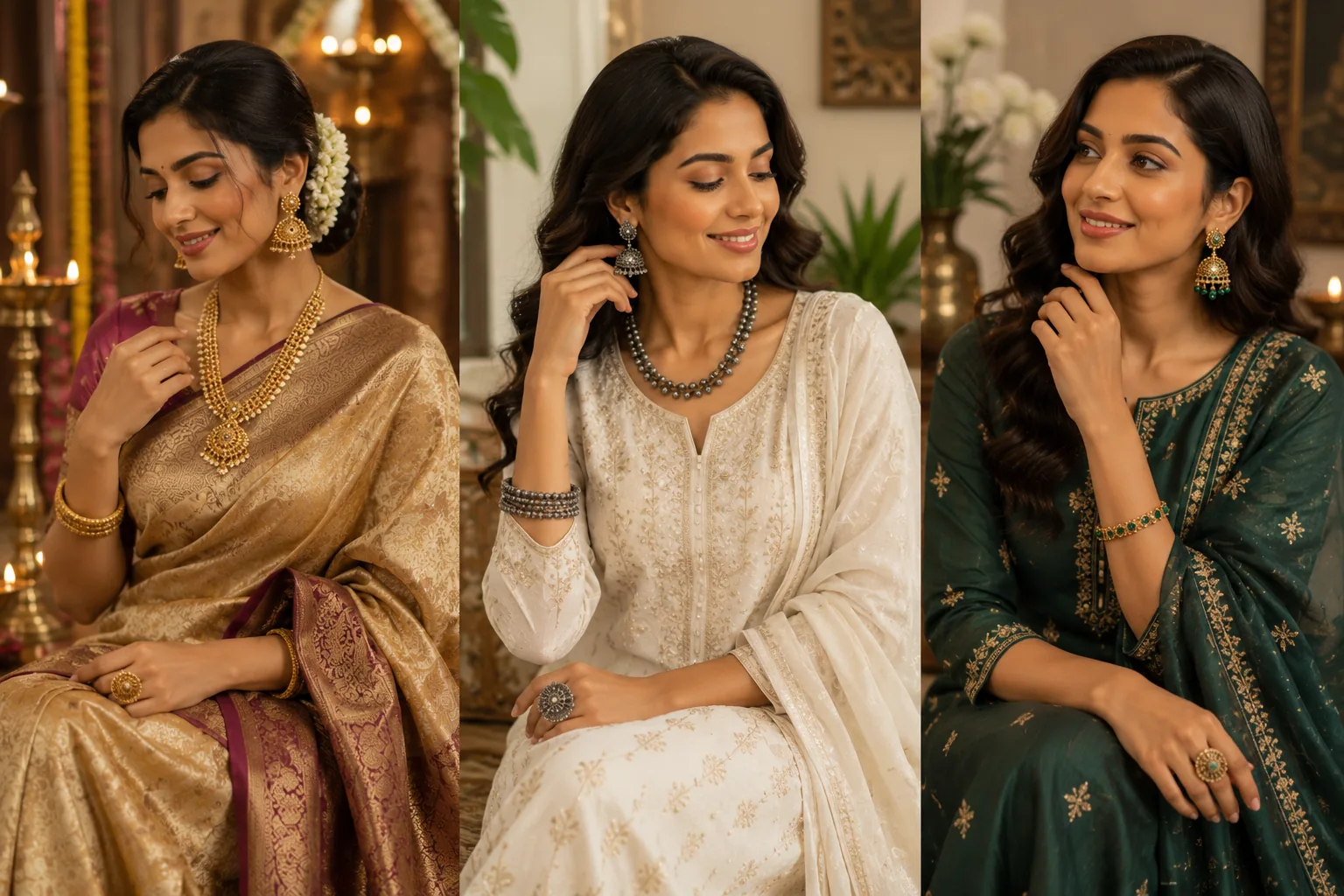
Let the craft choose the metal
The fastest way to look deliberate is to match the jewellery's language to the textile's. Zari-rich weaves — Banarasi, kanjeevaram, brocade — carry warm metals: gold, kundan, polki, temple jewellery. Handloom cotton, khadi, ikat and chikankari pull the other way: oxidised silver, beaten brass, terracotta, beads and thread work.
Cross the streams knowingly, never accidentally. A heavy kundan choker on plain khadi looks borrowed; silver jhumkas on a Banarasi vanish against the zari. Pearls are the diplomats, comfortable on both sides of the line. The quickest check works in one glance: if the saree carries gold in its border, echo it; if it carries none, silver will not be missed. When neither metal feels right, thread and terracotta step in — craft answering craft.
One hero zone — ears, neck or wrists
Ethnic jewellery scales fast, so ration the attention:
- Statement jhumkas or chandbalis → bare or minimal neck, one thin bangle
- A worked necklace or choker → small studs, quiet wrists
- A bangle or kada stack → plain ears, no necklace
Weddings tolerate two zones if one clearly leads; everyday ethnic wants the opposite — a single pair of small jhumkas or a thin chain finishes a work kurta without announcing itself. The restraint maths is the same as layering jewellery anywhere: every added piece divides the attention the last one earned. Cameras exaggerate clutter, so if the outfit will be photographed all evening, the one-hero rule only tightens.
Neckline logic decides the necklace
Read the neckline before the jewellery box. Deep U and V blouses are built for necklaces — the pendant should end above the neckline's lowest point, never wrestling with it. Boat necks, collars and high-neck blouses refuse necklaces entirely; give them earrings and let the neckline be the design. Bandhgala-style closures behave exactly the same way.
Off-shoulder and halter blouses hand the whole stage to earrings and perhaps a cuff. Sarees add one more reading: a heavy pallu over the left shoulder crowds a necklace on that side, which is why seedha-pallu drapes — pallu brought to the front — pair so well with layered chains and long haars.
Scale to the occasion
Daily wear: studs or small jhumkas, a thin chain, a watch — craft over carat. Festive: proper jhumkas, a stack of glass or metal bangles, perhaps the nose pin's day out. Wedding guest: one genuine hero — a kundan choker, a temple necklace, serious chandbalis — with everything else in supporting roles. Bridal party is the only tier where maang tikka, haath phool and layered necklaces coexist by design.
Moving one tier above your role reads as effort; moving two reads as competing. And comfort is a style decision: past a certain weight, earrings change your posture by hour three. Ear-chains and screw-backs exist for exactly this reason — use them without apology. A guest who can laugh, eat and dance in their jewellery has chosen it correctly.
Budget has nothing to do with it
The logic above works identically at every price. Oxidised silver from a street market, terracotta from a craft fair, glass bangles at forty rupees a dozen, lac from Jaipur, fresh flowers at a mehendi — all legitimate, all styleable. What matters is condition and coherence: untangled chains, brightened silver — toothpaste and an old brush revive it — and backs that match their fronts.
Heirlooms mix in freely. Your grandmother's gold jhumkas over a plain mulmul kurta is the whole high-low philosophy in one look, and modern saree styling leans on exactly this contrast. Buy less, repeat shamelessly, and let one good pair of jhumkas quietly serve a decade of occasions.