 SKIBDRIP®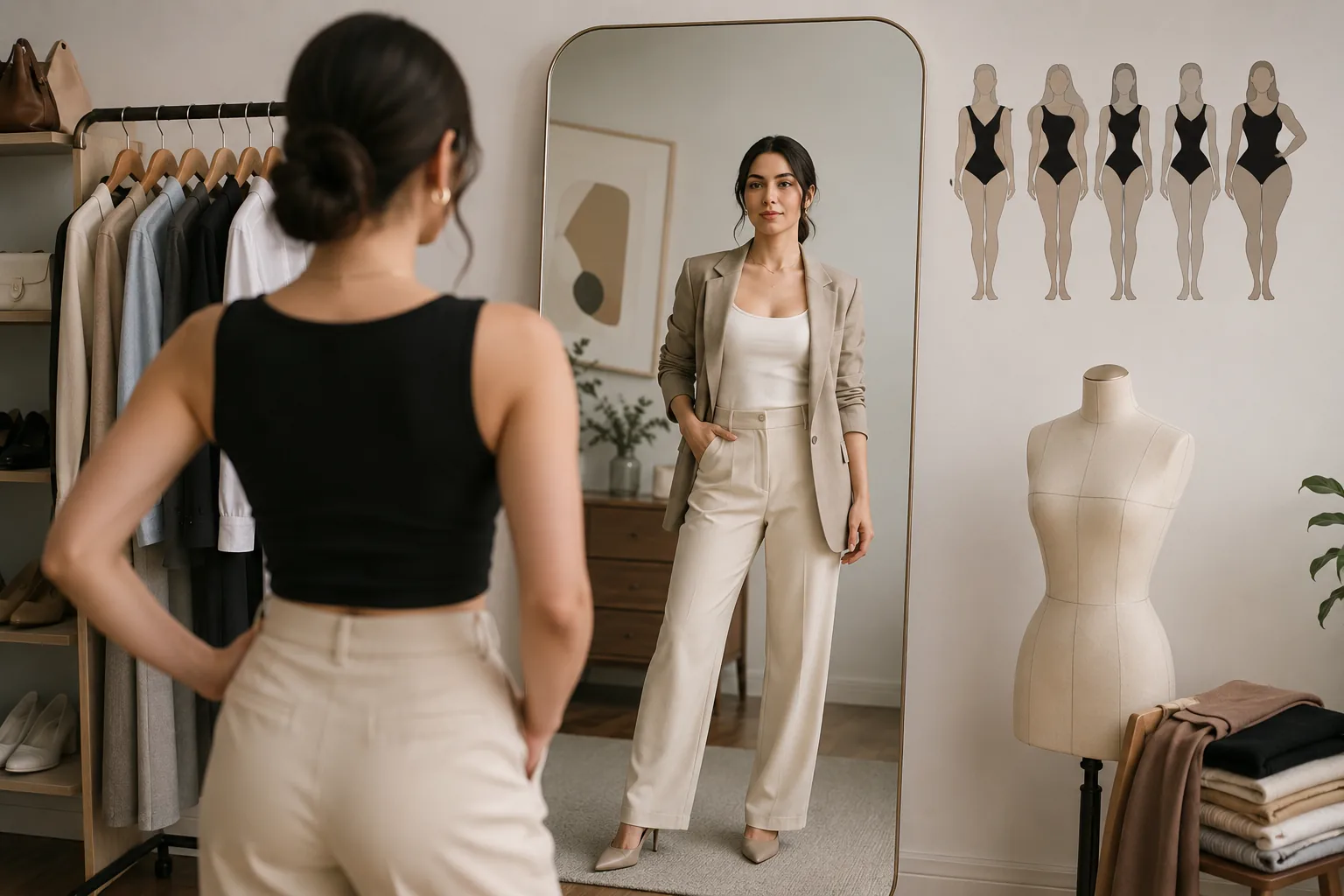
What body typing is — and what it is not
Dressing for your body type is often sold as a list of prohibitions. It is actually much simpler and much kinder: clothes create optical effects, and knowing your proportions tells you which effects do what on you. The same wide-leg trouser lengthens one person and shortens another — not because either body is wrong, but because the trouser meets different proportions.
So drop the language of fixing. There is nothing to fix. There are only proportions — the relationships between shoulders, waist, hips and legs — and levers that shift how those relationships read. What you do with the levers is taste, not obligation. Every guideline that follows is an offer: use what serves the way you want to look, ignore the rest freely.
Find your proportions in five minutes
Stand square to a mirror in fitted clothes or underwear and observe four things without judgement:
- Shoulder line versus hip line — which is visually wider, or are they close to equal
- Waist — clearly narrower than both, slightly defined, or fairly straight through the middle
- Where you carry fullness — through the middle, through hips and thighs, through bust and shoulders, or evenly
- Leg-to-torso ratio — where your legs read as starting from, relative to your height
A tape measure across shoulders, waist and hips settles anything the eye cannot. That is the whole diagnosis — four observations, no categories required yet, and no number on the tape means anything beyond geometry.
The four levers every outfit pulls
All body-type advice reduces to four levers.
Structure adds visual width and presence exactly where it sits — padded shoulders, stiff fabrics, breast pockets, pleats. Drape does the opposite, letting fabric fall past a point rather than gripping it — bias cuts, fluid viscose, open layers. Emphasis pulls the eye — a belt marks the waist, a neckline frames the collarbone, a bright shoe drops attention to the floor. Line stretches or divides — an unbroken column of colour lengthens; a contrast waistband or hem cuts height into segments.
Read any outfit through these four and the mystery dissolves: you are simply choosing where width, softness, attention and length go today.
The common shapes, briefly and gently
The classic labels are shorthand for proportion patterns, nothing more. Pear: hips read wider than shoulders — balance, if you want it, comes from the top half. Apple: fullness gathers through the middle, with strong legs and shoulders to show. Hourglass: shoulders and hips near-equal with a defined waist that most clothes are not cut for. Rectangle: shoulders, waist and hips run close to one line — a frame that wears drape and tailoring beautifully. Inverted triangle: shoulders lead, and the styling question is whether to soften or celebrate them.
Most people are a blend, and weight, age and life shift the pattern over time. The labels serve you only as an index to the right techniques — never as an identity or a scorecard.
Fit beats formula, and preference beats both
Whatever your proportions, garments that fit properly do more than any body-type trick: shoulder seams ending at the shoulder bone, waistbands sitting where they were cut to sit, hems breaking where they should. Half of all figure frustration is actually fit frustration — the right silhouette in the wrong size will always disappoint.
And the final authority is you. If a guideline says wide-leg trousers balance you but you feel strongest in slim jeans, wear the slim jeans; conviction reads from further away than proportion ever does. Use the toolkit on days you want it. The best-dressed version of you is the one who decided, not the one who complied.