 SKIBDRIP®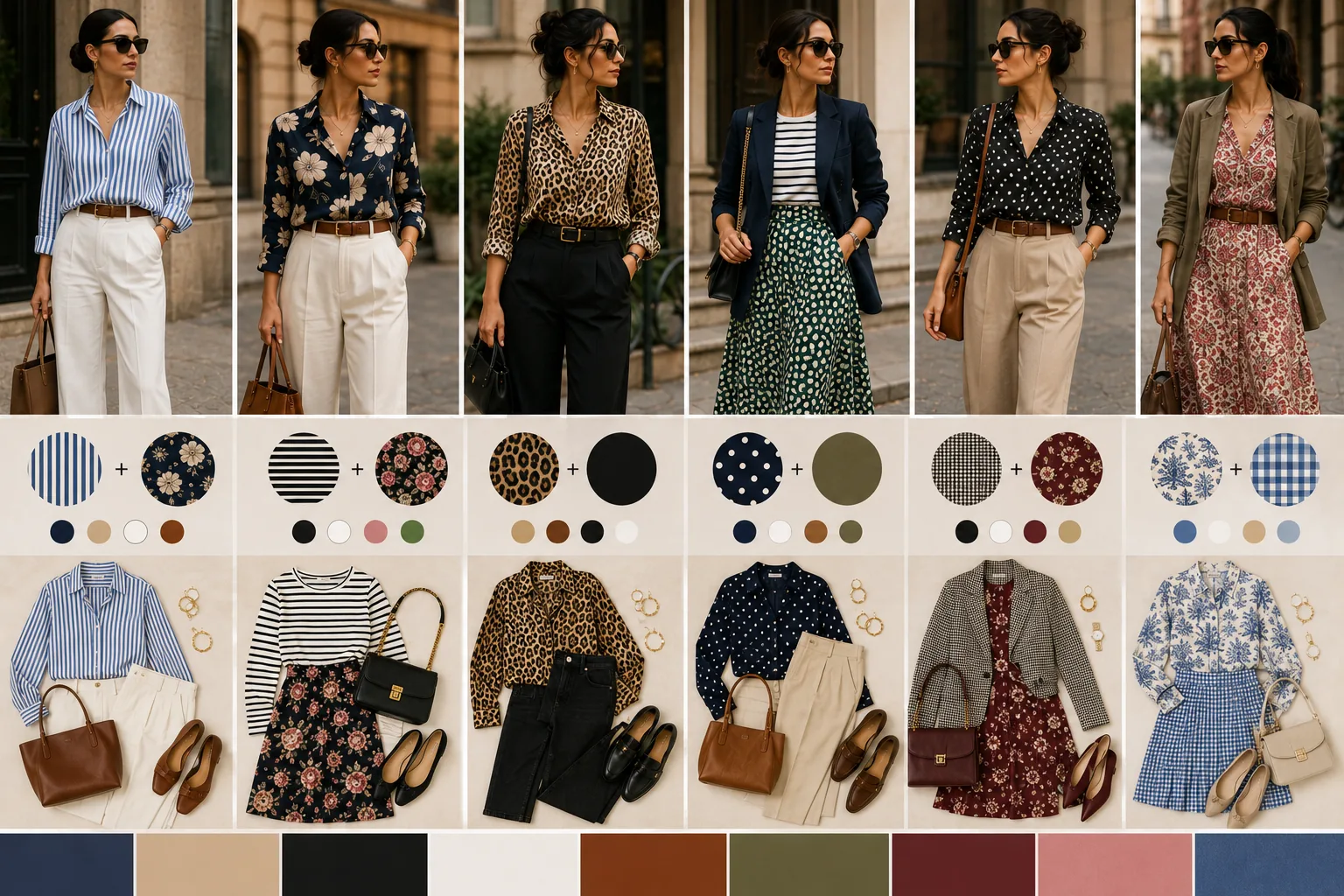
The two rules that make clashing impossible
Every successful print mix obeys two rules.
Share a colour. The prints must have at least one colour in common — a navy running through both the stripe and the floral ties them into one story. The eye finds the repeat and relaxes.
Vary the scale. One print large, one small. The small print then reads almost as texture while the large one leads. Two large prints compete for the same job; two small ones buzz. Scale difference is what separates a styled clash from a genuine one — check it at arm's length in the mirror, where the outfit is actually seen. Up close every mix looks busy; distance is the honest judge.
The starter pairings
Some prints are natural diplomats. Begin here.
- Stripes with florals: the classic first mix — a breton tee under a floral skirt
- Leopard with nearly anything: animal print in its brown-black range behaves as a neutral, so leopard flats under stripes or gingham simply work
- Polka dots with stripes: both geometric, both orderly
- Same print, two scales: a fine gingham shirt with a bigger gingham skirt
Keep both prints on the same side of the colour temperature line and the pairing settles further. Stripes are the universal donor — when in doubt, make one of the two prints a stripe.
Anchor with solids
Prints need silence around them. In a two-print outfit, let solid pieces — jacket, shoes, bag, belt — hold at least a third of the picture, ideally in a colour lifted straight from one of the prints.
A floral midi, breton tee and denim jacket: the denim is the anchor. A leopard skirt, striped knit, black boots and bag: black is the anchor. Without an anchor the eye has nowhere to rest, and the outfit reads as noise even when the rules were followed. Three prints is expert mode — possible, but only with one shared palette and disciplined steps of scale. The waist is the natural border post — a belt or a tucked hem gives two prints separate territories.
Prints, bodies and placement
Scale reads relative to frame: larger prints sit naturally across larger areas and taller frames, smaller prints suit smaller frames and smaller zones. But placement matters more than any body rule — print draws the eye, so put it where you want attention. A printed top for face-forward days, a printed skirt to anchor a plain shirt, a printed scarf as the risk-free first experiment.
India hands you a native advantage: bandhani with stripes, a Banarasi weave against fine block print, florals over ikat — the shared-colour rule is exactly how a printed dupatta has always been matched to a contrast kurta. You have been mixing prints for years; only the vocabulary is new. Trust that instinct whenever the western rules feel abstract.
A one-week practice plan
Learn it on the body, not in theory.
- Day one: a leopard or printed accessory with a striped tee — accessories cannot fail
- Day three: stripes plus floral, denim anchor, shared colour checked
- Day five: the same print in two scales, or polka dots with stripes
- Weekend: your boldest pair, photographed — the camera confirms what the mirror hedges
Keep the three-colour ceiling across both prints combined, and when a mix feels almost right, swap one print for its smaller-scale cousin — more often than not, scale was the problem. After a week the fear is gone and the compliments start. Keep the two easiest wins in weekly rotation and the wardrobe starts suggesting pairs on its own.