 SKIBDRIP®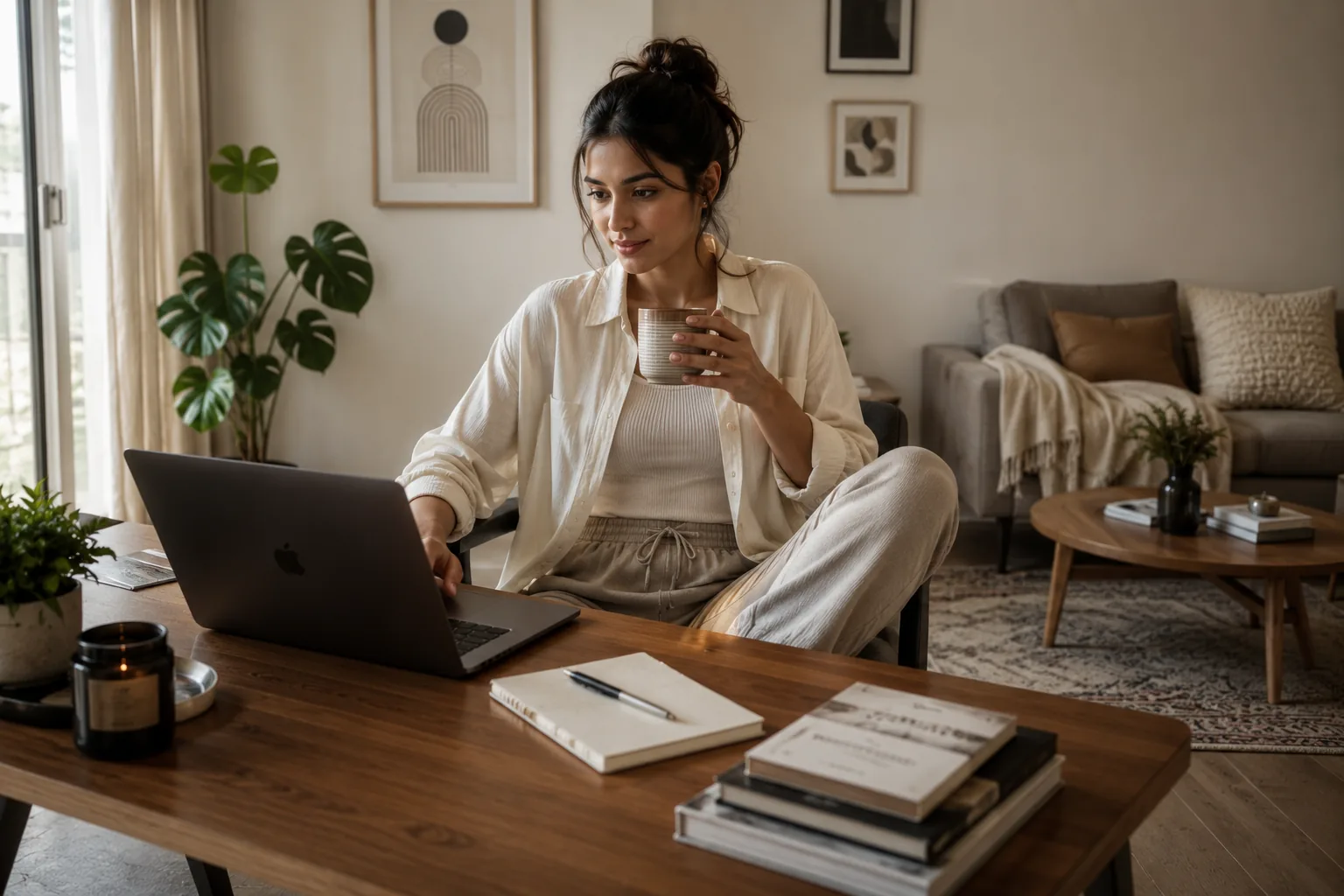
Why all-day pyjamas backfire
The commute used to change your state; now clothes have to do it alone. Psychologists call the effect enclothed cognition — what you wear nudges how you think and perform. Waking clothes tell your brain the day has started; sleep clothes keep whispering that it has not.
Nobody is arguing for a blazer at your dining table. The argument is for a deliberate change: out of what you slept in, into something chosen for working. The garments can be nearly as comfortable — the signal is the change itself, and it costs ninety seconds.
The three-piece WFH formula
One formula covers almost every home-working day:
- Bottom: soft trousers that still hold a line — knit chinos, dark tailored joggers, ponte trousers, relaxed jeans. Elastic waist allowed; collapsed shape not.
- Top: something you would answer the door in — heavyweight plain tee, knitted polo, oxford shirt, cotton kurta.
- Third layer: a cardigan, overshirt or decent hoodie hung on the chair.
The standard to hold: comfortable enough for ten hours of sitting, presentable enough that a surprise video call or courier finds you ready. That line is exactly casual without sloppy.
The camera layer
Video calls judge a narrow strip: shoulders to mid-chest, in your room's light. Keep one grab-layer within arm's reach of the desk — a structured overshirt, dark cardigan or collared jacket — and you are meeting-ready in five seconds.
On camera, solid mid-tones beat both pure white, which blows out, and busy fine patterns, which shimmer on screen. A collar or a visible neckline structure reads authoritative; a stretched crew neck does not. And dress the bottom half anyway — the day you stand up mid-call to fetch a charger is the day the rule proves itself.
Mark the edges of the day
Without a commute, work leaks. Clothes can rebuild the walls. Morning: change into the work formula, even on no-call days — it starts the clock. Evening: change again, into genuinely off-duty clothes. That second change is the one people skip, and it is the one that tells your head the laptop is closed.
Shoes are optional at home, but keeping separate daytime and evening slippers is a surprisingly effective trick. Ritual does the job the train used to. If evenings keep dissolving into the laptop, put the change of clothes on the calendar like a meeting — it feels absurd for a week, and then it works.
The hybrid day
Plenty of home days are only half home: a 4 pm client visit, the school run, a gym slot, dinner out. Dress for the day's most public hour, then subtract for the desk — not the other way round, because upgrading at 3.55 pm never happens.
Practically: wear the office-worthy trousers all day and keep the softer top until you leave, or dress fully and work with sleeves rolled. Shoes wait by the door, decided in the morning. The test for any hybrid outfit is the doorstep test — could you leave in ninety seconds without a costume change? If yes, the day can move and your clothes will keep up.
Keep a small, hard-working rotation
You need less than a full wardrobe: three bottoms, five or six tops, two camera layers — all machine-washable, all crease-shrugging, all combinable. Treat it as a mini uniform and mornings disappear.
Spend where the camera looks and the body sits: one good knitted polo outperforms four thin tees on screen; one pair of properly nice soft trousers makes the desk chair civilised. Rotate, wash promptly, and refresh the tees the moment they grey — on camera and at the door, fabric condition is most of the message. Review the rotation each season; home clothes age invisibly because nobody comments.